
If you are looking for a safe, predictable way to grow your money in Kenya (one where your capital is backed by the government and your returns are guaranteed), treasury bills and bonds deserve your attention. For years, these instruments were the preserve of banks and institutional investors. That has changed. Through the Central Bank of Kenya’s DhowCSD platform, any Kenyan adult with a national ID, a KRA PIN, and a bank account can now invest directly from their phone. This guide explains exactly how treasury bills and bonds work, what the current rates look like, and how to get started step by step.
What Are Treasury Bills and Bonds in Kenya?
Both treasury bills (T-bills) and treasury bonds (T-bonds) are government debt instruments issued by the Central Bank of Kenya (CBK) on behalf of the National Treasury. When you invest in either, you are essentially lending money to the Kenyan government in exchange for a fixed return. Because the borrower is the government, these are among the lowest-risk investments available in the country.
The key difference between the two is time and structure.
Treasury bills are short-term instruments with maturities of 91 days, 182 days, or 364 days. They are sold at a discount, meaning you pay less than the face value upfront and receive the full face value at maturity. The difference between what you paid and what you receive is your return. For example, at a 91-day T-bill rate of 7.56%, you pay approximately KSh 98,114 for a KSh 100,000 bill. After 91 days, the CBK pays you the full KSh 100,000; and the KSh 1,886 difference is your tax-free profit.
Treasury bonds are long-term instruments with tenors typically ranging from 2 to 30 years. Unlike T-bills, bonds pay a fixed coupon rate every six months (a regular interest income) and return your principal at maturity. Most treasury bonds in Kenya offer a fixed rate, meaning the interest rate determined at auction is locked in for the entire life of the bond, making them a predictable, long-term source of income.
In short: T-bills give you a lump-sum return at the end of a short period. Bonds give you a steady income stream over a longer period, plus your principal back at the end.
Current Treasury Bill and Bond Rates in Kenya (2026)
Rates change with every auction and are influenced by the CBK policy rate, inflation levels, and investor demand. Here is where rates stand as of the most recent auctions:
Treasury Bills (as at the April 30, 2026 auction):
| Tenor | Rate |
| 91-Day T-Bill | ~7.73% |
| 182-Day T-Bill | ~7.78% |
| 364-Day T-Bill | ~8.27% |
Treasury Bonds (recent auctions, 2026):
| Bond | Tenor Remaining | Coupon Rate |
| FXD1/2020/015 | ~8.9 years | 12.756% |
| FXD1/2018/025 | ~17.3 years | 13.400% |
| May 2026 bond offerings | Various | 12.0% – 13.924% |
T-bill rates have declined significantly since mid-2024, tracking the CBK policy rate cuts that have cumulatively reduced the benchmark rate by 425 basis points (from a high of 13% down to 8.75%) as the bank pursues an easing cycle to stimulate growth. The MPC held the rate steady at 8.75% at its April 2026 meeting, suggesting further large cuts are unlikely in the near term.
An important tax note: interest on T-bills is exempt from withholding tax for individual investors as of March 2026, making the effective yield significantly higher than instruments like bank deposits or money market funds where 15% withholding tax applies. A 7.56% T-bill yield is roughly equivalent to an 8.9% pre-tax return elsewhere. Treasury bonds, however, are subject to 10% withholding tax on coupon interest.
Always check current rates directly on the CBK website at centralbank.go.ke/bills-bonds/treasury-bills before investing, as they are published after every weekly auction.
Treasury Bills vs. Treasury Bonds: Which Is Right for You?
| Factor | Treasury Bills | Treasury Bonds |
| Term | 91, 182, or 364 days | 2 to 30 years |
| Minimum investment | KSh 50,000 (non-competitive) | KSh 50,000 (non-competitive) |
| Return type | Discount (lump sum at maturity) | Semi-annual coupon payments |
| Withholding tax | Exempt for individuals | 10% on interest |
| Current return range | 7.73% – 8.27% (tax-free) | 12% – 13.9% (before 10% WHT) |
| Liquidity before maturity | Rediscount via CBK (last resort) | Secondary market via NSE or broker |
| Best suited for | Short-term savings goals, emergency buffers, beginners | Long-term income, retirement planning, school fees planning |
If you have a specific savings goal within the next year (a land deposit, building materials, or a business purchase), T-bills offer predictable, tax-free returns with a clear end date. If you are investing for the long term and want regular income every six months, bonds are the better vehicle. Many experienced investors use both: T-bills for short-term liquidity and bonds for the bulk of their long-term portfolio.
How to Invest in Treasury Bills and Bonds in Kenya (Step-by-Step)
The entire process can be done from your phone or computer using the CBK’s DhowCSD platform. Here is how it works from start to finish:
Step 1: Register on DhowCSD
Download the DhowCSD app from Google Play or the Apple App Store, or access the portal at dhowcsd.centralbank.go.ke. Registration requires a valid email address, an active Kenyan mobile number, your KRA PIN, your national ID or passport, a passport-size photo, and your settlement bank account details.
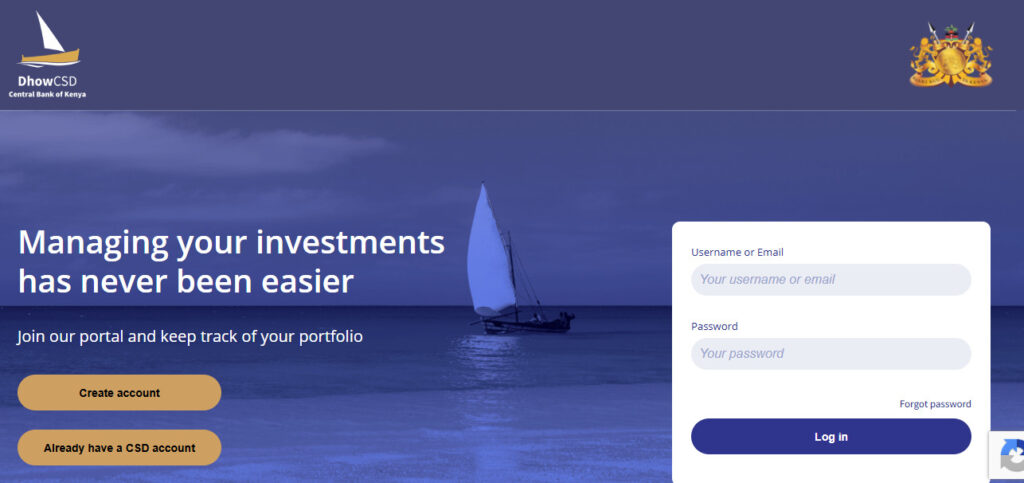
The registration process must be completed within seven days, or the system will automatically delete your incomplete profile. Account opening is free, and approval typically takes two to three business days.
Step 2: Monitor upcoming auctions
Once your account is active, log in and click on the Auctions tab to see what is currently on offer. The CBK auctions 91-day, 182-day, and 364-day T-bills every week, with results published on the CBK website and on their official social media channels. Bond auctions are less frequent and announced via a prospectus on the CBK website.
Step 3: Place your bid
Select your preferred security, click “Create Bid,” and choose between a competitive or non-competitive bid.
Non-competitive bids are recommended for retail investors. You accept whatever rate the market determines at auction and are guaranteed an allocation up to your bid amount. The minimum for non-competitive bids is KSh 50,000, with a maximum of KSh 50 million per CSD account per tenor.
Competitive bids require you to specify the exact yield you want. If your rate is too high relative to what the market clears at, your bid may be rejected. The minimum for competitive bids is KSh 2 million per CSD account per tenor; these are designed for institutional investors.
For beginners, always use non-competitive bids.
Step 4: Pay for successful bids
After the auction, log back into the DhowCSD portal under the Transactions tab to find your payment key and the amount owed. Payment must be made by 2:00 pm on the settlement date (typically the Monday after the auction for T-bills). CBK introduced M-Pesa payment integration in November 2025, allowing payments of up to KSh 250,000 directly through the DhowCSD system, a significant convenience for retail investors. Larger amounts are settled via RTGS bank transfer.
Step 5: Receive your returns
For T-bills, the bill is credited to your CSD account, and at maturity, the full face value is paid into your linked bank account automatically. For bonds, coupon payments are made every six months directly to your bank account, with the principal returned at maturity.
Step 6: Reinvest at maturity
When your T-bill matures, DhowCSD gives you the option to roll over your investment into a new auction. This is one of the most powerful features of the platform; consistent reinvestment compounds your returns over time without you needing to do anything manually.
Can You Invest in T-Bills Through a Stockbroker or Money Market Fund?
Not everyone has KSh 50,000 to start with, and not everyone wants to manage auctions directly. There are two alternative routes:
Via a licensed stockbroker or investment bank: Firms like Dyer & Blair, Faida Investment Bank, and Genghis Capital can invest in T-bills and bonds on your behalf through your commercial bank as custodian. This is convenient but typically involves fees that reduce your net return. For large investments or bond portfolios, a broker relationship can be worth it for the added service and support.
Via a money market fund (MMF): MMFs like Cytonn, Sanlam, and Britam hold T-bills as the main underlying asset in their portfolios. When you invest in an MMF, your money is indirectly exposed to T-bill returns. The advantages are a very low minimum (from KSh 100), daily compounding, and same-day or next-day liquidity. The trade-off is that management fees and the 15% withholding tax on MMF interest slightly reduce the net return compared to investing directly in T-bills where individual investors are currently exempt from WHT. For full details on money market funds, see our guide on how to save money in Kenya.
The cleanest rule of thumb is if you can meet the KSh 50,000 minimum and do not need access to the funds before maturity, invest directly via DhowCSD for the best net return. If you need flexibility or are starting smaller, use an MMF as the entry point and graduate to direct T-bill investment once your savings allow it.
What Are the Risks of Investing in Treasury Bills and Bonds in Kenya?
Treasury bills and bonds are among the safest investments available in Kenya, but they are not entirely without risk. Here is an honest assessment:
Default risk: Extremely low. The Government of Kenya has never defaulted on its domestic debt obligations. Your investment is backed by the full faith of the Republic of Kenya. For domestic currency-denominated securities, this risk is minimal.
Inflation risk: If inflation rises above your T-bill rate, your real return (after accounting for the loss in purchasing power) becomes negative. With inflation currently around 4.4% and 91-day T-bills at 7.73%, real returns are currently positive. However, this balance can shift if inflation spikes or rates fall further.
Interest rate risk: This mainly affects bond holders. If market interest rates rise after you have purchased a bond, the market value of your bond falls (because new investors can get better rates elsewhere). This only matters if you need to sell before maturity. If you hold to maturity, you receive your full face value regardless.
Liquidity risk: T-bills are not traded on the secondary market. If you need your money before maturity, the only option is to rediscount with the CBK; and the CBK will rediscount as a last resort at 3% above the prevailing market yield or coupon rate, which is a punitive rate designed to discourage early redemption. Treasury bonds can be sold on the secondary market via NSE or through a broker, but liquidity varies depending on the bond.
Reinvestment risk: When your T-bill matures, rates may be lower than when you originally invested. This is the current environment; rates have fallen significantly over the past year and may continue drifting lower. Building a laddered T-bill strategy (staggering maturities across 91-day and 182-day bills) partially mitigates this.
Tips for Beginners Investing in T-Bills and Bonds in Kenya
Start with a 364-day T-bill: It offers the highest rate among the three T-bill tenors, gives you a clear one-year learning cycle, and lets you understand the full process (from registration to maturity) before committing to the longer duration of a bond.
Always use non-competitive bids: You will always get your allocation, you accept the market-determined rate, and you avoid the complexity of rate speculation. Competitive bids are for institutions and experienced investors.
Only invest money you will not need before maturity: T-bills should be treated like a fixed deposit; put in money you can genuinely set aside for 91, 182, or 364 days. If you need flexible access, an MMF is the right tool. A good approach is to keep an emergency fund in an MMF and invest surplus savings beyond that into T-bills.
Reinvest at maturity to compound your returns. The DhowCSD auto-rollover feature makes this easy. Consistent reinvestment over two to three years is where the real wealth-building effect of T-bills shows up.
Ladder your T-bill investments for regular liquidity. Invest in a mix of 91-day and 182-day bills so that one matures roughly every month or two. This gives you access to a portion of your capital regularly without breaking any single investment early.
Track auction schedules and results on the CBK website or follow CBK’s official WhatsApp channel for auction result notifications. Staying informed about rate trends helps you decide when to lock in a rate and for how long.
Frequently Asked Questions
What is the minimum amount to invest in treasury bills in Kenya?
The minimum for non-competitive bids is KSh 50,000, and you can increase your investment in multiples of KSh 50,000. For competitive bids, the minimum rises to KSh 2 million per CSD account per tenor. Treasury bonds follow the same minimums; KSh 50,000 for non-competitive bids and KSh 2 million for competitive bids.
How are treasury bill returns taxed in Kenya?
As of March 2026, interest on Treasury bills is exempt from withholding tax for individual investors; making them more tax-efficient than bank deposits or money market funds. Treasury bond coupon income is subject to a 10% withholding tax, which is deducted before interest is paid into your account.
Can I sell my treasury bill before maturity?
T-bills are not traded on the secondary market. If you need funds before maturity, you can request a rediscount through the CBK DhowCSD portal, but this is a last-resort facility charged at a punitive rate. Treasury bonds, however, can be sold before maturity through the NSE secondary market or via a stockbroker or bank.
How often does CBK auction treasury bills?
The CBK auctions 91-day and 182-day T-bills every week, typically on Wednesdays, with results published the same day. The 364-day T-bill is auctioned monthly. Bond auctions are less regular and are announced in advance via a prospectus on the CBK website.
Is investing in treasury bills safe in Kenya?
Treasury bills are among the safest investments in Kenya. They are direct obligations of the Government of Kenya, regulated by the CBK, and Kenya has never defaulted on its domestic debt. The primary risks are not capital loss but rather inflation eroding real returns and the inability to access funds before maturity without a penalty.
Build a Complete Investment Strategy
Treasury bills and bonds are an excellent foundation for any investment portfolio; safe, predictable, and now accessible to any Kenyan through DhowCSD. But they work best as part of a broader financial plan. Pair them with long-term equity exposure through the best mutual funds in Kenya or learn how to invest directly in Kenyan companies through our guide on how to buy shares on the NSE. If you are still building your savings base, start with our guide on how to save money in Kenya and our overview ofthe best SACCOs in Kenya for loans. Coming soon to SokoMix: a bond yield and T-bill return calculator — so you can quickly work out exactly how much your investment will earn before committing. In the meantime, browse the SokoMix classifieds for financial services and investment opportunities listed by Kenyan providers.