
Getting a bank loan as a small business owner in Kenya is harder than it should be. Banks want collateral, a formal payslip, at least two years of audited accounts, and a credit history that most informal traders simply do not have. Microfinance institutions exist to bridge exactly that gap. They were built to serve the market traders, jua kali artisans, farmers, chama groups, and early-stage entrepreneurs that mainstream banking overlooks. This guide covers the best microfinance options in Kenya in 2026, what rates and loan limits to expect, what to check before signing anything, and how MFIs compare to SACCOs and banks for SME lending.
What Is Microfinance and Who Is It For?
Microfinance institutions (MFIs) are licensed financial organisations that provide small loans, savings products, and related services to individuals and businesses that are underserved by commercial banks. Since the Micro Finance Act of 2006 created a regulated framework for small business lending, Kenya’s microfinance sector has grown significantly; by 2010, more than twenty large institutions were providing credit to approximately 1.5 million active borrowers. Today the sector is larger, more diverse, and increasingly digital.
There are two categories of MFIs operating in Kenya:
- Deposit-Taking Microfinance Banks (DT-MFBs): DT-MFBs are licensed and regulated by the Central Bank of Kenya. They can accept deposits, offer savings accounts, and provide full banking services alongside loans. Examples include KWFT, Faulu, SMEP, Sumac, and Rafiki. These are the most established and safest to borrow from.
- Credit-Only MFIs: Credit-Only MFIs are regulated under the Microfinance Act but do not take deposits. They focus purely on lending, often to groups or individuals in specific sectors. Examples include Musoni and Juhudi Kilimo.
The typical MFI borrower is a market trader, hawker, bodaboda operator, farmer, jua kali artisan, chama member, or small business owner who needs between KSh 10,000 and KSh 1 million to grow their business but does not have property to use as collateral.
The core advantage over banks: MFIs use group guarantees, business cash flow, or M-Pesa transaction history to assess creditworthiness, not land title deeds or log books. The trade-off is cost. Interest rates at MFIs typically range from 15% to 30% annually due to higher operational costs and the riskier profile of their borrowers compared to commercial bank clients. This is higher than a SACCO or a bank, but for many small business owners, it is the only accessible credit available.
What to Check Before Applying for a Microfinance Loan in Kenya
The commercial intent behind this decision matters. Before committing to any MFI loan, go through this checklist:

CBK licence status. Only borrow from institutions licensed by the Central Bank of Kenya or regulated under the Micro Finance Act. You can verify any MFI’s licence status at centralbank.go.ke. Unlicensed lenders operate outside any regulatory protection and can charge rates with no ceiling.
Reducing balance vs. flat rate. Always ask how interest is calculated. A flat rate of 15% means you pay 15% on the full original amount throughout the loan, even as you repay. A reducing balance rate of 15% means interest is only charged on the outstanding balance — which is significantly cheaper over time. Many MFIs quote monthly rates (e.g. 1.5% per month) rather than annual rates, which can obscure the true cost. Multiply the monthly rate by 12 to get the approximate annual figure.
Total cost of credit. The interest rate is not the full picture. Add up all the fees: loan appraisal fees, insurance fees, processing fees, and any mandatory savings or share purchase requirements. These can add 3–8% to your effective borrowing cost on top of the stated rate.
Repayment frequency. Some MFIs collect daily or weekly, which can strain a business with uneven daily revenue. Monthly repayment is generally more manageable for most small businesses. Confirm the schedule before signing.
Group vs. individual loan. Group loans typically carry lower rates and more flexible collateral requirements because the group members jointly guarantee each other. Individual loans offer more privacy and flexibility but usually require more documentation or a guarantor.
Prepayment penalties. If you plan to repay early once your business picks up, confirm whether the MFI charges a penalty for early settlement. Some institutions charge a flat fee; others do not.
CRB clearance. Most MFIs conduct Credit Reference Bureau (CRB) checks. If you have a negative CRB listing from an unpaid digital loan or a previous default, address this before applying.
Best Microfinance Institutions in Kenya for Small Business Loans
1. Kenya Women Microfinance Bank (KWFT)
Best for: Women-owned businesses of all sizes, across all counties
KWFT is one of the oldest and most popular microfinance institutions in Kenya, licensed by the CBK in 2010. It has over 600,000 clients and more than 231 branches across all 47 counties. Despite the name, KWFT focuses exclusively on women borrowers, which makes it the largest women-focused MFI in Africa by client reach.
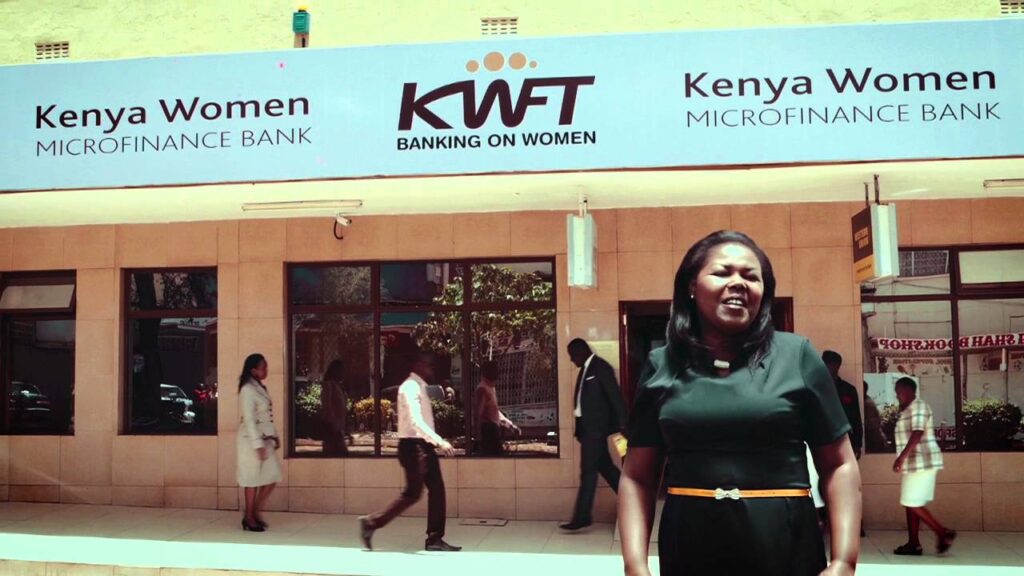
KWFT offers individual and group loans from KSh 10,000 to KSh 1 million at interest rates between 18% and 24% annually. Loan installments can be deposited via M-Pesa, and the bank offers a range of savings accounts alongside its credit products. Group loans carry lower rates and are accessible even to first-time borrowers with no credit history.
How to apply: Visit any KWFT branch with your National ID, KRA PIN, and passport photo. Group loans require a registered group of at least five members. Individual loan applicants may need to demonstrate business cash flow via bank or M-Pesa statements.
2. Faulu Microfinance Bank
Best for: Small traders and business owners needing fast turnaround, NGO employees
Founded in 1991 as a loan scheme in Mathare by Food for the Hungry International, Faulu has grown into one of Kenya’s top deposit-taking microfinance banks, offering banking, investment, savings, insurance, and mobile banking solutions.
Faulu offers loans from KSh 5,000 to KSh 1 million with repayment periods of 6 to 24 months and interest rates of approximately 18% per year. Loan approval and disbursement typically takes one to two business days. Faulu also lends to NGO employees and offers asset financing for business equipment. Its Ngong Lane head office and nationwide branch network make it accessible in most urban and peri-urban areas.
How to apply: Walk into a Faulu branch or inquire through their website. You will need your National ID, KRA PIN, passport photo, and evidence of business activity. Group applicants need their group registration certificate.
3. SMEP Microfinance Bank
Best for: SMEs in trade, agriculture, and church-linked community groups
SMEP (Small and Micro Enterprise Programme) was established by the National Council of Churches of Kenya (NCCK) and focuses on retail banking, SME lending, and group banking. It has a strong presence among church and community-linked savings groups.
SMEP offers loans from KSh 20,000 to KSh 3 million with repayment periods of 6 to 36 months and interest rates of approximately 16% per year. For the SME loan, eligibility includes having a registered business with at least six months of operation, an active SMEP savings account, and proof of cash flow via bank statements or sales records. The interest rate is approximately 1.5% per month on a reducing balance (18% p.a.), plus a 2% appraisal fee and 1% insurance.
Group loans start from as low as KSh 5,000. To access a SMEP group loan, you must create or join a registered self-help group of at least fifteen members.
How to apply: Visit a SMEP branch or apply at smep.co.ke. Group applicants must present their group registration certificate. Individual business borrowers need standard KYC documents and business records.
4. Musoni Microfinance
Best for: Business owners who prefer fully digital, paperless lending
Musoni is one of the youngest microfinance institutions in Kenya, having been registered in 2009. The “M” stands for mobile; all funds are sent and received through mobile money, making it the most paperless MFI in the market.
Musoni offers loans from KSh 5,000 to KSh 1.2 million with repayment periods of 6 to 18 months and interest rates of approximately 14% per year, lower than most comparable MFIs. Musoni charges no hidden fees, no registration fees, and loans are processed and disbursed within 72 hours of application approval. The institution has physical branches where you can get support, but all money transactions are conducted via M-Pesa.
How to apply: Visit a Musoni branch or contact them directly. Group and individual applications are accepted. You will need your National ID, KRA PIN, and an M-Pesa-registered SIM card.
5. Sumac Microfinance Bank
Best for: Urban small business owners and salary earners needing asset financing
Sumac Microfinance Bank offers loans from KSh 10,000 to KSh 1.5 million with repayment terms of 6 to 24 months and interest rates of approximately 17% per year. The bank focuses on urban SMEs and salary-based borrowers, with a particular strength in asset financing; useful for traders who need equipment, machinery, or stock without tying up large amounts of working capital.
Sumac is headquartered at Consolidated Bank House on Koinange Street in Nairobi and has branches in major towns. Loan approval is typically within two business days, and the bank is known for straightforward documentation requirements and consistent customer support throughout the loan period.
How to apply: Visit a Sumac branch with your National ID, KRA PIN, passport photo, and business or employment records.
6. Faulu Kenya: NGO & Agri Loans
Best for: Agricultural value chain borrowers, NGO workers, and rural SMEs
Beyond its standard business loan products, Faulu has specific loan products designed for NGO employees and agricultural businesses; two borrower categories that many MFIs overlook. Faulu’s agriculture-focused products cover crop financing, livestock acquisition, and agri-business working capital, with repayment schedules designed around harvest cycles rather than fixed monthly instalments.

Faulu also operates a strong mobile banking platform, accepting loan repayments via M-Pesa Pay Bill, and has a network that extends into rural Kenya, making it a practical choice for borrowers outside Nairobi.
7. Rafiki Microfinance Bank
Best for: Diaspora Kenyans and rural/peri-urban borrowers
Rafiki Microfinance is one of the few MFIs in Kenya that offers diaspora banking, savings, and loan services alongside standard domestic products. This makes it a good option for business owners whose family members in the diaspora want to co-guarantee or support a local business loan.
Rafiki has branches in several counties and offers business loans, asset financing, and group lending products. It is regulated by the CBK as a deposit-taking MFI, giving depositors and borrowers the protection of the regulatory framework.
8. Juhudi Kilimo
Best for: Small-scale farmers and agribusiness owners needing asset financing
Juhudi Kilimo is a credit-only MFI with a singular focus: financing agricultural assets for smallholder farmers. Rather than cash loans, Juhudi typically finances the purchase of specific productive assets (dairy cows, beehives, irrigation equipment, solar drip kits, and livestock) with the asset itself acting as the collateral.
Repayment is structured around the productive capacity of the asset rather than a standard monthly schedule. For a farmer who cannot access a standard business loan but needs productive assets to grow income, Juhudi Kilimo fills a gap that no other institution on this list does.
Microfinance vs. SACCOs vs. Commercial Banks: Which Is Right for Your Business?
| Factor | Microfinance Bank | SACCO | Commercial Bank |
| Eligibility | Very flexible — informal traders, groups, farmers | Requires savings history and sector membership | Formal business, credit history, collateral |
| Collateral | Usually not required | Usually not required | Usually required (property, assets) |
| Interest rate | 14–24% p.a. | 12–18% p.a. | 13–20% p.a. |
| Loan limits | KSh 5,000 – KSh 5M | Based on savings (2–5x) | KSh 50,000 – unlimited |
| Processing speed | 1–14 days | 1–7 days | 14–60 days |
| Best suited for | Informal sector, first-time borrowers, groups | Employed individuals with savings history | Established businesses needing large loans |
The honest summary: SACCOs offer the best rates but require you to save consistently before you can access a loan; read our full guide on the best SACCOs in Kenya for loans to understand how to qualify. Banks are best for large, long-term loans once your business has a track record. MFIs sit in the middle; faster, more accessible, and less documentation-heavy than banks, but more expensive than SACCOs.
For urgent, short-term cash flow gaps, also see our guide on how to get an M-Pesa loan in Kenya; though mobile lending should only be used for genuine short-term emergencies, not as recurring business finance.
What Documents Do You Need for a Microfinance Loan in Kenya?
Requirements vary by institution and loan size, but here is the standard checklist for most MFI loan applications:
- National ID or valid passport
- KRA PIN certificate — essential for all licensed lenders
- Passport-size photograph
- Business permit or registration certificate (required by most MFIs for business loans above KSh 50,000)
- Business cash flow evidence — bank statements, M-Pesa statements (last 3–6 months), or basic sales records
- Group registration certificate (for group loan applicants)
- Guarantors (for some individual loan products)
For smaller loans (particularly group loans under KSh 50,000) requirements are lighter. For larger individual loans above KSh 500,000, some MFIs may request a simple business plan or a profit and loss statement covering recent trading activity. For business loans below KES 300,000 from MFIs (especially for groups) a formal business plan is generally not required.
One important note for 2026: if you have a negative CRB listing from unpaid digital loans or past defaults, address this before applying. All formal lenders conduct CRB checks, and a positive repayment history significantly improves your chances of approval and may result in better rate offers.
Government and Development Finance Options for Small Businesses
Beyond MFIs, several government-backed funds offer small business loans at rates that are often significantly cheaper, though they require more patience in the application process.
Hustler Fund (SME Tier): The Hustler Fund SME tier, accessible via *254# on any network or through the M-Pesa Mini App, requires only a KRA PIN and a registered business. It charges 7–9% per annum and disburses within 3 to 7 days. It is the most accessible government loan product for informal businesses in 2026 and requires no paperwork or guarantors.
Women Enterprise Fund (WEF): WEF provides credit to women entrepreneurs at 8% annual interest. Individual women can borrow up to KSh 500,000, while women’s groups can access up to KSh 2 million. The fund has gone fully digital and can be accessed via M-Pesa. Group members must all be female Kenyan citizens aged 18 or above with active M-Pesa accounts.
Youth Enterprise Development Fund (YEDF): YEDF provides loans from KSh 10,000 to KSh 2 million at 8% annual interest, specifically for entrepreneurs aged 18 to 35, operating through constituency offices and financial intermediaries across all 47 counties.
Uwezo Fund: Targets youth, women, and persons with disabilities operating as groups. Groups that have been registered and actively operating for at least six months can access up to KSh 500,000 per cycle at very low rates. Processing typically takes 45 to 60 days at constituency level.
The key trade-off with government funds is speed; most government fund applications take 60 to 90 days from submission to disbursement, with the exception of the Hustler Fund SME tier. If you need capital urgently, an MFI is faster. If you have time and meet the eligibility criteria, government funds offer rates that no MFI can match.
For a broader look at funding options beyond loans, see our guide on SME grants and funding opportunities in Kenya.
Frequently Asked Questions
Which microfinance gives the highest loan in Kenya?
Among regulated MFIs, SMEP Microfinance Bank and Faulu Microfinance Bank offer some of the highest loan limits — SMEP up to KSh 5 million for SME loans and Faulu up to KSh 1 million for individual business borrowers. KWFT offers up to KSh 1 million for women entrepreneurs. Loan limits are always tied to your business cash flow, repayment history, and — for group loans — the collective savings and credit history of the group.
Can I get a microfinance loan without collateral?
Yes. Most MFIs do not require physical collateral like land or a log book. Group loans use joint liability among members as the guarantee — members co-sign for each other. Individual loans may require a personal guarantor or be backed purely by demonstrated business cash flow and M-Pesa transaction history. This is the primary advantage of MFIs over commercial banks for informal sector borrowers.
What is the interest rate for microfinance loans in Kenya?
There are currently 17 microfinance loan products available in Kenya with interest rates ranging from 14% to 26% per annum. The lower end (around 14%) applies to digital, group-based lenders like Musoni. The higher end (20–26%) is common for individual emergency or working capital loans. Always ask whether the rate is applied on a reducing balance or a flat rate, as this changes your total repayment amount significantly.
How long does it take to get a microfinance loan?
Digital MFIs like Musoni can disburse within 72 hours of application approval. Most branch-based MFIs take between 3 and 14 days for group loans and 7 to 21 days for individual business loans. Larger loans requiring more documentation take longer. For urgent needs, the Hustler Fund SME tier is the fastest formal option at 3 to 7 days with minimal paperwork.
What is the difference between a microfinance bank and a SACCO?
Both serve borrowers who may not qualify for commercial bank loans, but they work differently. A SACCO is member-owned — you save within it, build ownership through shares, and borrow based on your accumulated savings. A microfinance bank is a regulated financial institution that lends to clients without requiring prior savings history. SACCOs generally offer lower rates (12–18% p.a.) but require you to save consistently over time before borrowing. MFIs are more immediately accessible but charge higher rates (14–26% p.a.).
Build Your Business With the Right Financial Tools
Accessing the right loan is just one piece of the puzzle. Before borrowing, it helps to have a clear plan for how you will use the capital and how you will manage repayments. Our guide on how to start a business in Kenya with KSh 10,000 covers the basics of getting a small business off the ground with limited capital, and our how to save money in Kenya guide can help you build a savings buffer alongside your borrowing. If you are considering a SACCO as an alternative or complement to an MFI loan, see our guide on the best SACCOs in Kenya for loans. Ready to find customers, suppliers, or services for your small business? Browse the SokoMix classifieds and post your business listing for free.