
Land fraud costs Kenyans billions of shillings every year. People lose entire life savings (money saved over decades) to fake title deeds, plots sold to multiple buyers simultaneously, and sellers who have no legal right to the land they are advertising. These are not rare edge cases. They happen in Nairobi, Kiambu, Machakos, Mombasa, and across the country, to buyers who trusted without verifying.
The good news is that verifying land ownership in Kenya has never been easier or cheaper. Through the government’s Ardhisasa platform, you can run an official land ownership search from your phone for KSh 500 (in under 30 minutes) before you commit a single shilling to a seller. This guide explains what Ardhisasa is, how to use it step by step, how to read the results, what to do if the land is not yet on the platform, and the red flags that should make you walk away from any deal.
What Is Ardhisasa and Why Does It Matter?
Ardhisasa (Swahili for “land now”) is Kenya’s official digital land registry, the National Land Information Management System (NLIMS). It was launched in April 2021 for Nairobi and is the government’s platform for conducting land searches, registering transactions, and verifying title deed details online.
Before Ardhisasa, all land records in Kenya were stored in physical files at the Lands registry. These paper records were vulnerable to tampering, alteration, loss, and outright fraud by corrupt officials and fraudulent sellers. Transferring, searching, or verifying land required physical visits to Ardhi House, long queues, and often weeks of waiting.
As of 2026, transactions in Nairobi (including transfers, leases, searches, and charges) are fully digitized through Ardhisasa. The National Stamp Duty Module has been rolled out nationwide, making manual stamp duty processing a thing of the past across all counties. The government has announced plans to roll Ardhisasa out to all 47 counties, and it is currently in active rollout in Kiambu, Isiolo, Mombasa, and Machakos, with Nairobi and Murang’a already fully operational.
For land buyers, the significance of this is enormous. A search result from Ardhisasa is legally recognised, reflects the current state of the official land registry in real time, and can be used for due diligence, bank loan applications, and court proceedings. It is the most reliable ownership verification tool available to any Kenyan, and it costs KSh 500.
What Can You Find on Ardhisasa?
Before running a search, it helps to know exactly what you are looking for. The Land Registry returns a Land Search Certificate that contains the registered owner’s name, the parcel size and location, the land tenure type (freehold or leasehold and its expiry date), and any encumbrances; registered charges (mortgages), caveats (legal restrictions), court orders, or other interests affecting the property.
In practical terms, a completed Ardhisasa search tells you:
Who legally owns the land: the registered owner’s full name and identification details. This is the person you must be dealing with, or someone who has been legally authorised to act on their behalf.
The land reference number and parcel description: the unique identifier for the plot, its physical location within the registration section, and its classified land use (residential, commercial, or agricultural).
The size of the parcel: the exact acreage as registered. You should verify this against what the seller has told you and, for large purchases, confirm it on the ground with a licensed surveyor.
Any registered charges: if a bank, SACCO, or MFI holds a charge against the land, it means the owner has used it as loan collateral. The lender must give formal consent before any sale can proceed, and the charge must be discharged (cleared) before you receive a clean title.
Any caveats or cautions: a caveat is a legal notice registered by someone claiming an interest in the property. A caution has a similar effect. Both prevent any transfer or dealing with the land until the issue is resolved. Do not buy land with an active caveat or caution.
Ownership history: previous transfers, how the land changed hands, and when.
Outstanding land rates: unpaid county land rates that must be cleared before a transfer can be registered.
This is why a land search is not optional; it is the only way to see the full legal status of a parcel at the time you are considering buying it.
How to Register on Ardhisasa
You must have an Ardhisasa account before you can run a search. Registration is free and takes about ten minutes.
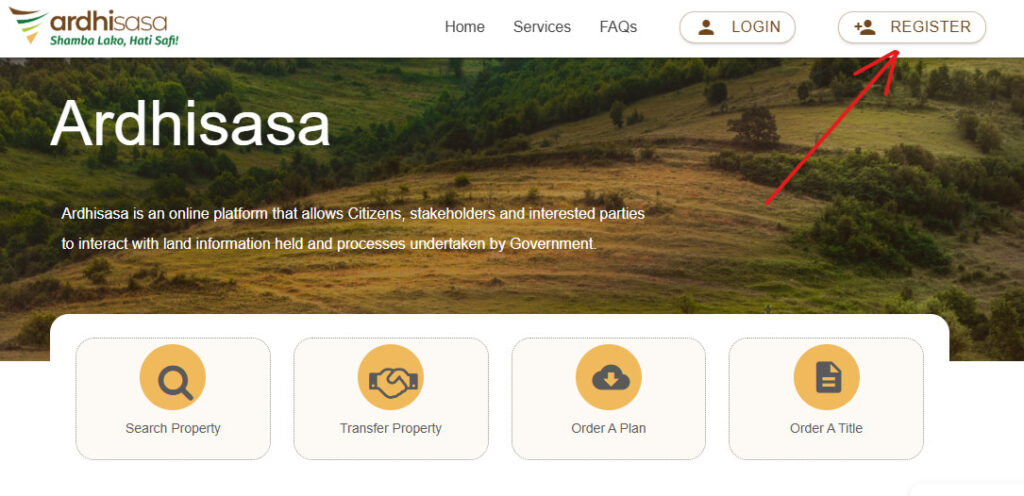
Step 1: Visit ardhisasa.lands.go.ke and click on the “Register” button.
Step 2: Select your registration category. Individual users register with their national ID number. Companies register using their Certificate of Incorporation number. Advocates and professionals register with their professional registration details.
Step 3: Fill in your personal details — your full name as it appears on your ID, national ID number, KRA PIN, phone number, and email address. The system validates your identity against government databases.
Step 4: Create a secure password and complete the verification steps, including the OTP (one-time password) sent to your registered phone number or email.
Step 5: Once registered, log in to access the dashboard where you can initiate transactions, track application progress, make payments, and download documents.
A few important notes: You will need a Kenyan phone number to receive OTP verification codes. The Ardhisasa mobile app is still under development as of 2026; access the platform through any mobile or desktop browser at the URL above. If you have difficulty accessing your registered email or phone for password resets, you can visit a Huduma Centre for in-person assistance.
How to Search for Land Ownership on Ardhisasa (Step-by-Step)
Once your account is set up, running the actual search is straightforward. Before you start, ask the seller for the land reference number (LR number) or title number; this is the unique identifier printed on the title deed. Without it, you cannot run a search.
Step 1: Log in at at ardhisasa.lands.go.ke using your ID number and password. On your dashboard, click on “Services” — you can access this via the quick links or the “View More” option.
Step 2: Select “New Application” in the right corner of the dashboard. This will direct you through the FAQs and terminology guide — worth reading if this is your first time on the platform.
Step 3: Select the type of search — for most buyers, this is “Official Land Search.”
Step 4: Enter the parcel number you are searching for and click “Add Parcel.” The system will list the parcel in your application.
Step 5: At this point, Ardhisasa requires the registered owner to consent to the search before results are released to a third party. This is a privacy and security measure, but it creates friction in practice. If a seller is willing to sell, they should have no reason to refuse consent. Refusal to allow a search is a significant red flag. The owner receives a notification and must approve the search from their own Ardhisasa account.
Step 6: Once the owner consents, pay the search fee. An official land search costs KSh 500 payable through M-Pesa, credit card, or debit card via the ArdhiPay payment module. Results are available instantly or within hours, compared to days under the manual system.
Step 7: Download your Official Land Search Certificate from your dashboard immediately. Save it — this is the legally recognized document your lawyer, bank, or SACCO will require for due diligence.
One important distinction: what you are running is an official search, which generates a formal certificate. This is different from a casual browser inquiry. Only the official search carries legal weight and is accepted by courts, banks, and conveyancing advocates.
How to Read Your Ardhisasa Search Results
Getting the search certificate is one thing, but understanding what it means is another. Here is how to interpret the key fields:
Owner name and ID: The registered owner’s name must match exactly with the person you are dealing with. If the seller’s name is James Kariuki but the title shows Jane Wanjiku, do not proceed until you have a full explanation; either a Power of Attorney, letters of administration from a deceased estate, or confirmation that you are dealing with the wrong person entirely.
Land tenure (freehold vs. leasehold): Freehold land has no expiry; you own it permanently. “Leasehold” means the land is held for a specific period, typically 99 years from the date of grant; check how many years remain on the lease. A leasehold with only 10 years remaining has very different value and financing implications from one with 80 years left.
Registered charges: A registered charge means the property has been used as collateral for a loan. The lender must consent to any sale, and the charge must be discharged before the buyer can receive a clean title. Ask the seller to provide written confirmation from the lender that the loan will be settled from the sale proceeds and that the charge will be discharged at completion.
Caveats and cautions: A caveat is a legal restriction registered by someone claiming an interest in the property. Do not proceed with any purchase if a caveat is registered until it is cleared. Caveats can be placed by co-owners, family members, creditors, or anyone with a legal dispute over the land. They do not go away on their own; they must be formally withdrawn or removed by court order.
Land size: Compare the stated acreage in the search certificate against what the seller told you. Any discrepancy (even a small one) warrants a physical survey before you proceed.
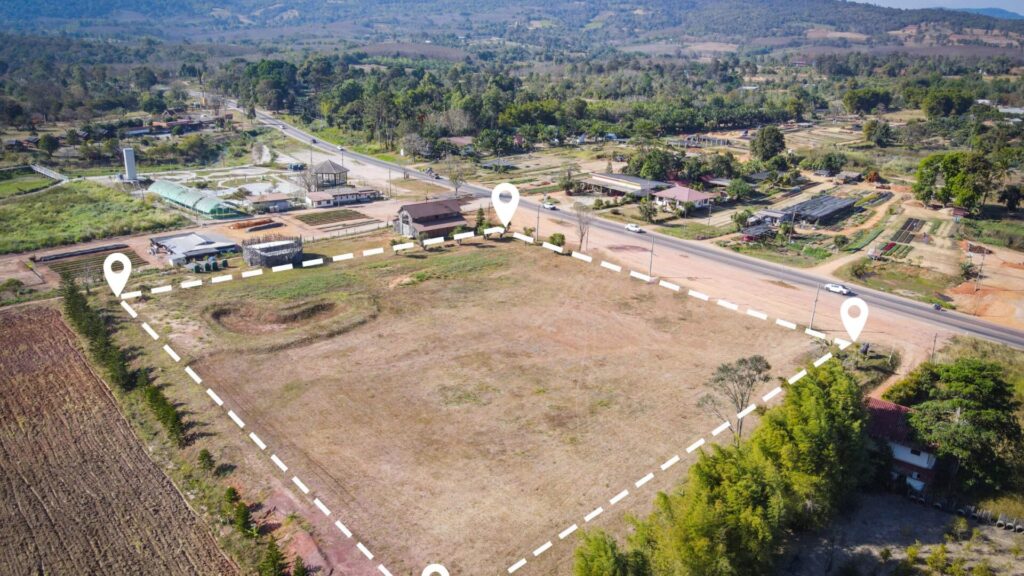
Land use classification: If the land is classified as agricultural but the seller is marketing it for residential development, additional change-of-use approvals are required. Do not assume subdivision or change of use is automatic; the process requires approval from the county government and the relevant planning authority, and it can take months.
What if the land is not on Ardhisasa?
A missing record on Ardhisasa does not automatically mean fraud. The property may be in a county not yet fully on Ardhisasa; it could be a sectional title for an apartment or flat (which the system does not cover), or the specific title block may not have been digitized yet. However, a missing record could also indicate a forged document; do not draw conclusions either way.
For land outside fully digitized areas, there are two alternative routes:
Via eCitizen: Log into eCitizen, find “Ministry of Lands, Public Works, Housing and Urban Development” on the dashboard, select “State Department for Lands and Physical Planning,” then choose “Search Land Ownership Records (RL27).” Fill in the property details exactly as they appear on the title deed, upload a clear scanned copy of the title deed, submit, and pay the KSh 1,000 fee via M-Pesa or card. Download your Certificate of Official Search as a PDF once processed. Note that eCitizen charges a small facilitation fee on top of the search cost.
Manual search at the county lands registry: Visit the county land registry where the property is registered, fill in Form RL 26 (Application for Official Search), attach a copy of the title deed and your national ID, pay the fee of approximately KSh 500, and collect your Land Search Certificate when ready; typically within 1 to 3 working days.
For some rural parcels registered under older land acts, either the Registration of Titles Act (RTA) or Government Lands Act (GLA), the search may need to go through Ardhi House in Nairobi, even if the land is in a different county. A conveyancing advocate can advise on the correct registry for any specific parcel.
The key rule: always insist on a search, regardless of which route is required. If the seller tells you “the records are not on the system yet” as a reason not to search, that is not an acceptable answer; it is a reason to search more carefully, not less.
Land Fraud Red Flags to Watch for in Kenya
Always remember: KSh 500 for a land search can save you millions in potential fraud losses. No legitimate seller will object to you conducting a proper search and verification process. If any of the following are present in a deal, treat it as a serious warning sign:
1. The seller cannot provide the LR number or parcel number. Every legitimate owner knows their land reference number. It is printed on the title deed. Inability or unwillingness to provide it is a major red flag.
2. The title deed is a photocopy or photograph. Always insist on the original. A photocopy can be fabricated easily. Examine the original for security features: genuine title deeds have watermarks, microtext, and a unique serial number. New 2026 titles include QR codes linking to Ardhisasa for instant verification.
3. The seller refuses to allow a land search before you pay a deposit. This is the single biggest red flag in any land transaction. A seller who will not allow verification before payment is almost certainly hiding something.
4. The selling price is significantly below market rate. If a plot in Ruiru is selling for KSh 300,000 when everything around it sells for KSh 800,000, ask why before you get excited. Fraudsters use unrealistic pricing to create urgency and override caution.
5. Multiple people or agents advertising the same plot. Double-selling (where a fraudster takes deposits from multiple buyers for the same parcel) is a common Kenyan land scam. If you see the same plot being advertised by different people or at different prices, investigate before paying anything.
6. The owner name on the search does not match the seller. The person selling you the property must either be the registered owner or have documented legal authority (a Power of Attorney or letters of administration) to sell on someone else’s behalf.
7. The title was issued very recently, and the seller is in a hurry to sell. This pattern is common in fraud cases where a title has been forged or illegitimately obtained and the fraudster wants to convert it to cash before the fraud is discovered.
8. The land has an active caveat, caution, or undisclosed charge. Any seller who says a caveat or charge is “not a problem” or “will be sorted” is asking you to take a legal risk that should be entirely theirs to resolve first.
9. Pressure to complete quickly. Urgency is a manipulation tactic. Legitimate sellers understand that due diligence takes time. Anyone who tells you “there are other buyers” or “the deal expires tomorrow” is applying psychological pressure specifically to bypass your verification instincts.
10. The seller refuses to allow a physical site visit or cannot show you the beacons on the ground. If you cannot stand on the land, see the boundary beacons, and verify its location matches the title description, do not pay for it.
Other Ways to Verify Land in Kenya
An Ardhisasa search is the foundation of due diligence, but it should not be the only step. For any significant land purchase, complement it with the following:
Physical survey: Hire a licensed surveyor registered with the Surveyors Registration Board of Kenya to confirm that the boundary beacons are in place and match the survey plan referenced in the title deed. This is essential for rural land and any parcel where the size or boundaries are unclear.
Local area checks: Talk to immediate neighbours and, where accessible, the area chief or local administration about the land’s history. Ask whether there are any known disputes, claims by previous occupants, or community issues with the parcel.
Land Control Board (LCB) consent: For agricultural land, any transfer requires LCB consent. Without it, the transfer is void regardless of what documents you sign. Verify that LCB consent has been obtained or will be obtained as part of the transaction.
Rates clearance certificate: Obtain a rates clearance certificate from the county government confirming that all outstanding land rates on the parcel have been paid. Unpaid land rates can block the transfer from being registered at the lands registry.
Licensed conveyancing advocate: Engage a licensed conveyancing advocate to handle the entire transaction — from agreement drafting to transfer registration. Advocates carry professional liability, conduct their own due diligence, and can identify legal issues that a non-expert buyer might miss. For any purchase above KSh 500,000, the advocate’s fee is one of the most important investments you can make.
Frequently Asked Questions
How much does a land search cost on Ardhisasa?
An official land search costs KSh 500 per parcel, payable via M-Pesa, credit card, debit card, or bank transfer through the ArdhiPay payment module. Manual searches at county land registries cost a similar amount, though some registries charge up to KSh 1,000. eCitizen adds a small facilitation fee on top of the search cost. Always confirm the current fee on the official platform before payment, as fees are periodically reviewed.
Can I search for land ownership by name in Kenya?
No — the official land search system requires a title number or LR (land reference) number, not a person’s name. You must obtain this from the seller before running a search. If the seller cannot or will not provide the title number, that is itself a red flag. Without the title number, a licensed advocate or surveyor can sometimes trace a parcel through older records or the Survey of Kenya, but this requires additional time and cost.
How long does an Ardhisasa land search take?
For fully digitised parcels in Nairobi and covered counties, results are typically available instantly or within a few hours after payment is confirmed. Manual searches at county registries take 1 to 3 working days. Note that the process requires the registered owner’s consent on Ardhisasa before results are released, which adds a step — if the seller is responsive, this should not cause significant delay.
Is a title deed enough proof of land ownership in Kenya?
No. A title deed alone is not sufficient — always conduct an official land search. The deed shows ownership; the search confirms it is genuine and current. Title deeds can be forged, altered, or used fraudulently by people who are not the registered owner. The official search certificate from the Lands Registry is the only document that reflects the current, verified status of the land at the time of the search.
What is the difference between a caveat and a caution on a title deed?
Both are legal instruments that restrict dealings with a piece of land, but they arise in different ways. A caveat is registered by someone claiming a beneficial interest in the land — for example, a co-purchaser who paid but was not put on the title, or a family member contesting a transfer. A caution is registered by the Registrar or a court to protect a specific interest, or may be placed by a spouse to prevent disposal of matrimonial property without consent. Do not proceed with the purchase of any land with an active caveat or caution until it is lifted by the person who placed it or removed by court order.
Protect Your Investment Before You Pay
A land search is not just a bureaucratic step — it is the single most important action you can take before buying land in Kenya. For KSh 500 and 30 minutes of your time, you can confirm that the person selling you land is who they say they are, that the land is free of legal encumbrances, and that the title deed you have been shown is genuine.
If you are actively looking for land or property to buy, browse listings on the SokoMix classifieds, where sellers post land, plots, and property for sale across Kenya. For a broader guide on the buying process, see our article on how to buy land near Nairobi and our upcoming guide on cheapest areas to buy land near Nairobi. When you are ready to proceed with a purchase, our guide on how to transfer a title deed in Kenya walks you through the full conveyancing process from search to registration. And if you are financing a land purchase, see our overview of the best mortgage rates in Kenya for what banks and SACCOs currently offer.